Constellation Museum
Background
The Constellation Museum was constructed as a form of personal comfort during the Spring of 2021. It is impossible for the piece and my process to escape the context of the isolation during the pandemic. Through Pearce et. al’s (2021) work on coping through the use of the video game Animal Crossing: New Horizons, I have come to understand that much of my process was driven by the need to create a space for myself, outside of reality, the need of maintaining goals for myself, control, and an activity where I could feel a sense of mastery.
In December of 2020 I was experiencing a large amount of stress. It was my first quarter at UCSC as a graduate student and rather than engaging with my fellow students naturalistically through proximity during the day, each interaction was regimented to the needs of our education and beyond that it seemed like everyone was too tired to make consistent connections with new friends.
I was also choking at that time on a large load of writing, half-self imposed by a class I was taking far earlier in my academic career than I had any right too and a fairly harsh practice exam. I also was taking my responsibilities as a TA this first quarter quite seriously. Negotiating those work and class boundaries online as well as presenting as a model of sanity for both the students I TAed and my fellow classmates exhausted me. Many nights saw me staying up late bingeing cartoon’s until I was so tired I couldn’t help fall asleep.
Inspiration
It was amidst this cyclone of stress and cycles of procrastination and poor sleep that I came to Michaela Joffe’s LoFi Virtual Museum (LVM). The museum is built using RPG Maker MV which brought with it a constrained set of interaction-types and presentation method which shaped the space’s aesthetic. Despite the low-detail abstraction and perhaps clunky methods of interaction, the museum created for me a very tangible sense of place when I needed someplace to escape to.
On examination, each piece chosen for exhibition was represented by photographic recordings from the Seattle Art Museum online collections, with description. Within the navigable museum space however, each piece is represented only with highly pixelized planar images. In order for sculptural pieces to inhabit the three-dimensional space, each was constructed from two intersecting panels to create an approximate view from most angles or, alternatively, a singular flat sprite.

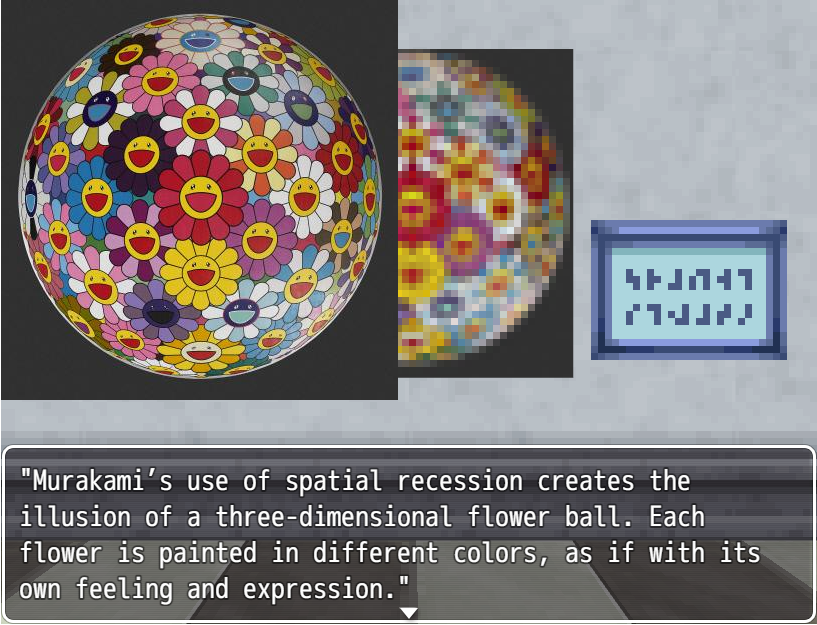
On active inspection each piece is represented by a higher resolution photograph, exploding the simple, abstract representation. Through the contrast between the style of the space and photographic real of the reference images, we come to recognize that the art itself is where our eyes should live and not the simulacrum of the museum. The museum is populated with other patrons, each concerned with perhaps a blocked off hallway, or someone else looking at a weird piece of art, or perhaps ready to question you about what a piece was about or to comment on the constructed nature of the space itself. Each is represented also by a highly pixelated facsimile. The focus on the art itself and the acknowledgement of the simulated space create a space where reality is suspended and we can address art as a primary discourse.
Construction
As a class, Media Constellations engaged with past histories of technology. We sought to disrupt the dominant narratives of generation and linear progress and reimagine the narratives around the history of computer technologies. One assignment would serve as the seed which would become the Constellation Museum.
Each student was tasked with the creation of a set of artwork that remixed the constraints of historical systems and re-imagining media which could have, but did not, come into existence if only as a result of contingencies. All of these pieces would be created in lvllvl, a tool specifically designed for this sort of speculative remixing.
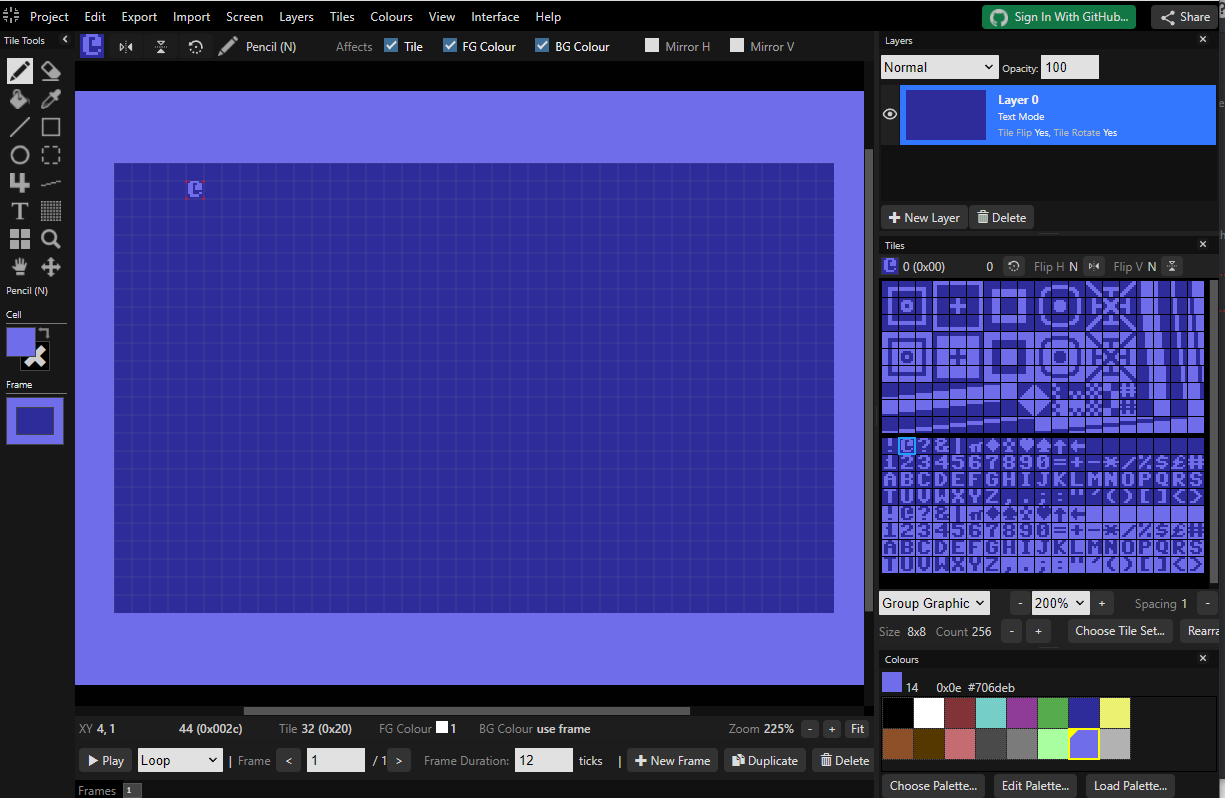
After completing my set, I was proud, but struggled to contextualize my work. As PNGs on the screen, each felt so small. Remembering back to Joffe’s museum, I decided “hell, I know enough about Unity to create a space for these”. I did not have to worry about learning the ins-and-outs of Unity, having worked with it through an entire 170-series game project. I was competent with the tool and could make steady progress. I only grew more excited as I saw the work of other students. They blew my pieces out of the park. It became “that art needs a place to live” instead of “my art needs a place to live”.
Writing about it roughly nine-months later, I can’t say there was any plan. I didn’t perform research on what galleries looked like or how pieces were strategically arranged. Each choice was free to be made from a mindset of pure situated action: what felt good at the time. I definitely needed the shadow of the wall to draw a line on the floor (that felt good). Yes, that is the perfect beige for the art stands and walls. This is the perfect brown to accent that beige.
I strove to apply the least complex strategies possible. I applied prior experience in Unity and constructed the space out of cube primitives and light objects. I used lighting maps so that I wouldn’t have to worry about the processing cost of multiple real-time lights when it ran with WebGL in the browser. While most of the lighting is placed across ceilings, I include a warm tinted point light outside of the galleries to create a sense of present time detectable via the shadow cast by the roofs and walls of the buildings.
I use a low-fidelity skybox (made with Clip Studio Paint) to create a sense of an outside seen through the window. This was an exploratory process. CSP was a new program and I wanted to see what it could do at lower-fidelities. Because it is ultimately a secondary detail, like the walls or flooring, I did not feel pressured to make something perfect. It just needed to not be a void. Like the LoFi museum I was taking inspiration from, the gallery inside would primary just be a place for the pieces and shouldn’t draw attention itself.
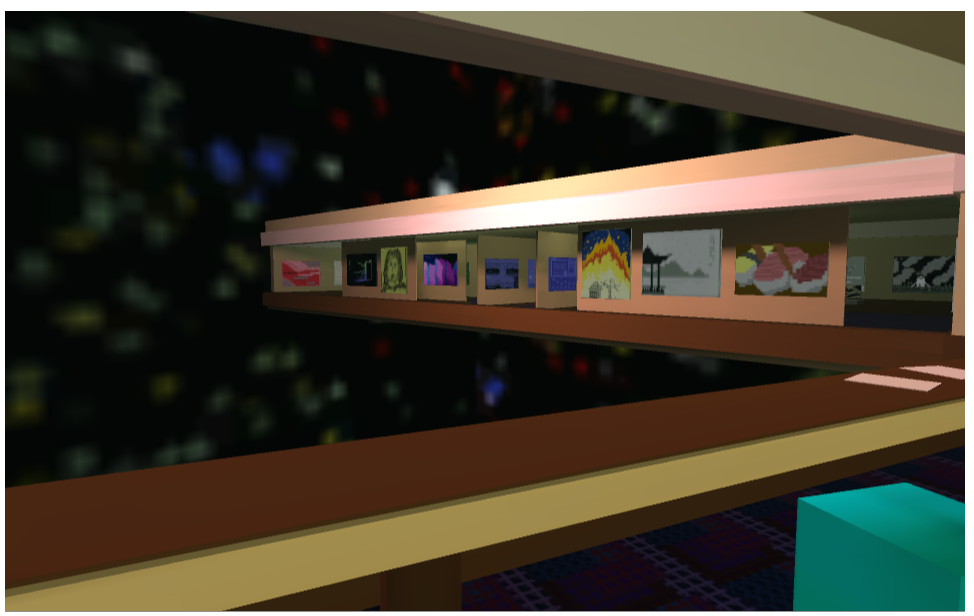
Everything was a scaled cube or cylinder. The art, simple textures applied to panels floating right on the wall. No need to complicate the design with realism. In fact, the unreal way that shaders can present the images freed me from any worries an actual exhibit designer would have to worry about in regards to lighting. I was granted freedom from that problem thanks to unlit shaders. Physical gallery spaces must contend with the play of natural light on the exhibits distorting their color and compositions. The light sources within this virtually gallery do not touch the pieces on display at all! The digital nature of the space also allowed me to incorporate the animated artworks created by other students in the class. A simple script to cycle through textures. When was the last time you went to a gallery where the paintings moved?
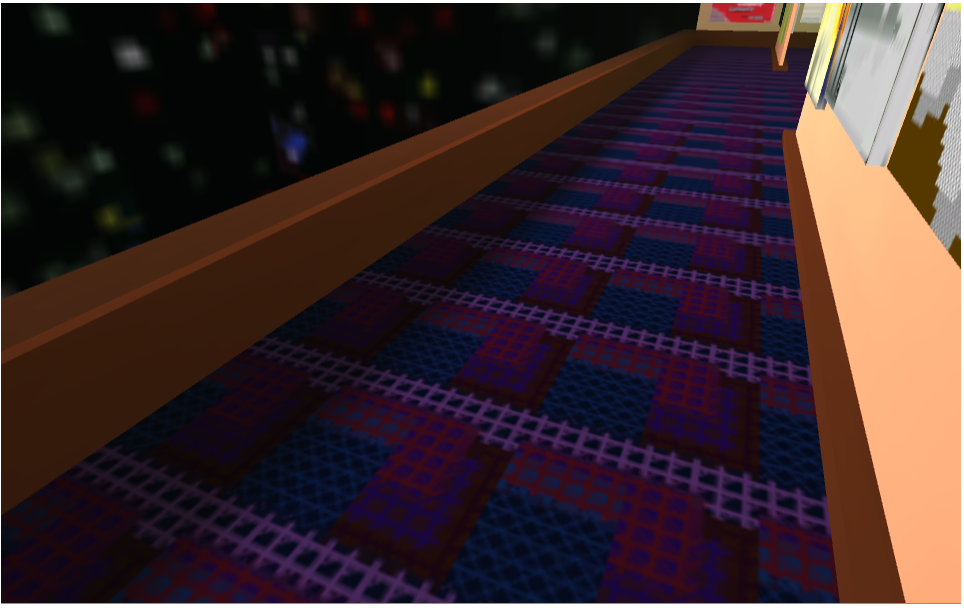
At some point I realized I needed carpeting. In continuing my strategy of operational simplicity, I took one of the pieces already in the assets folder, my abstract skyline, applied a tint to it and tiled it across the floor cube. The dark red-blue-purple pattern evoked in me memories of the local bowling alley and the miniature golf-arcade I spent time at as a child. It was kitschy and slightly nostalgic: perfect
Once I got permission from other classmates to include their art, I would need another wing just to include it all. I copy-pasted the architecture I had, and then realized that I would have extra open space that could play into how I arranged the works. Originally I planned to group the artwork by artist, but as more came in it became clear that shared themes were emerging. If I was going to do the artwork justice, I would have to take on the role of curator and frame the art within larger contexts. Some pieces required distance to see them correctly; I established open spaces and lines of sight across the gallery so that these pieces could shine. The split into two wings provided available distance for this arrangement. The distance also allowed for the establishment of a destination, “that big green one” and arrival. This narrative, however simple, heightens viewers’ interaction with the artwork. The theme of “drowning” arose from various pieces, so those became grouped. “Pastoralism” became another theme and was treated with proximity to cow-print benches(textured from an image created using the same tool as each piece of artwork lvllvl).
Non-exhibit components of the museum were added to enhance the sense of place, a motivating feature from the start. By the end of the project, working in it had become a meditation; I wanted it feel lived in; I wanted to go there and maybe if I added enough stuff I could manifest it into reality. I added details: a table that a student (me) could sit at; vending machines (textured again, even their normal maps generated with lvllvl) created from memories of the UCSC library; a dream of an arcade machine in the corner.
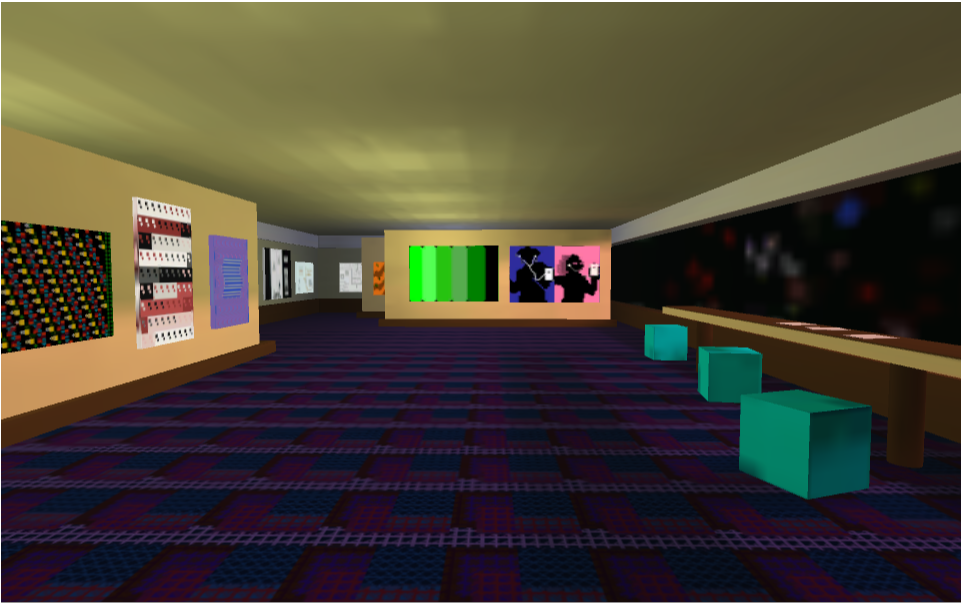
I wished I could have manifested the space into reality. I wanted this peaceful space away from the worries of isolation and loneliness and guilt. In the 1620’s Anthony van Dyck was trapped in the city of Palermo due to plague. He painted several pieces, the same scene in variation: St. Rosalia beseeching the heavens to end the suffering of Palermo. I’m not religious, I’m not a painter, but I like to think that feeling of trying to bring a end or a respite into being via stubbornness and work is shared.
Once the class was finished and I had included everyone’s pieces. I was done. I shared it on the channels available to me. I hoped that someone would reach out and say, “wow, this is cool”. That didn’t happen, but it didn’t need to. As a piece the Constellation Museum gave me a space to exist outside of a stressful isolation for many hours. For that I am thankful.
References
McCloud, Scott Understanding Comics Chapter 2
Joffe, Michaela. LoFi Virutal Museum. https://joffeorama.itch.io/virtual-lofi-museum
Pearce, K. E., Yip, J. C., Lee, J. H., Martinez, J. J., Windleharth, T., Li, Q., & Bhattacharya, A. (2021, October 21). “I Need to Just Have a Couple of White Claws and Play Animal Crossing Tonight”: Parents Coping With Video Games During the COVID-19 Pandemic. Psychology of Popular Media. Advance online publication. http://dx.doi.org/10.1037/ppm0000367